↓
 

@jeremybartlett.bsky.social

Generic selectors
Exact matches only
Search in title
Search in content
Post Type Selectors
Filter by Categories
Edible
Foraging
Fungi
General
Ornamental
Poisonous

Jeremy Bartlett's LET IT GROW blog

The wonder of plants and fungi.

Jeremy Bartlett's Let It Grow Blog
  • Homepage
  • About Let It Grow
  • Contact Me
  • All My Posts
"People from a planet without flowers would think we must be mad with joy the whole time to have such things about us." - Iris Murdoch

Post navigation

← Previous Post
Next Post→

Balm-leaved Archangel, Lamium orvala

Jeremy Bartlett's LET IT GROW blog Posted on 28 April, 2020 by Jeremy Bartlett28 April, 2020
Lamium orvala

Balm-leaved Archangel, Lamium orvala, in close up.

The garden is full of beauty at the moment, as spring reaches its peak. Today it is raining, and this rare event should refresh and rejuvenate after weeks of warmth and sunshine.

One of the many plants in flower at the moment is Balm-leaved Archangel, Lamium orvala, also known as Balm-leaved Red Deadnettle. It is by no means the showiest plant in the garden, compared with the ‘Canary Bird’ rose, the huge Marsh Marigolds (Caltha palustris) in both ponds, or the tumbling masses of our Clematis alpina ‘Helsingborg’ and Clematis motana ‘Mayleen’. I only have the one plant and it almost hides in the border. But close up, the flowers have a rich beauty all of their own.

Lamium orvala is a member of the family Lamiaceae, a relative of the lovely White Deadnettle (Lamium album), and the Red Deadnettle (Lamium purpureum), one of my favourite flowers, which I wrote about in April 2012.

I first saw Lamium orvala at Chestnut Farm, West Beckham, a lovely North Norfolk garden that is sometimes open for the National Gardens Scheme, where it was providing ground cover beneath a tree. Later, when I had a chance to buy a plant, I did.

Lamium orvala is a herbaceous perennial which flowers in spring (April and May, even in June in some places). Its leaves are larger and lusher than those of White or Red Deadnettles, with prominent veins, giving them an almost quilt-like appearance, and finely toothed leaf margins. The flowers are sumptuous, a deep dusky pink, with an especially lovely flared, spotted lower lip. They have been described as being “almost orchid-like“. They should be attractive to bees, but in our garden bees visit Red and White Deadnettles instead, probably because we grow more of them, in sunnier parts of the garden.

The plant likes damp shade or semi-shade. I grow it in semi-shade and my soil is a bit too well drained to be ideal but nonetheless my plant keeps going year after year. It is in the middle of the border, where it is hidden by other plant growth once the flowers are finished, and this also protects it to some extent from summer’s heat and drought. It is very hardy, with a UK hardiness rating of H7, tolerating temperatures of -20 Celsius or lower.

Lamium orvala is a native of central eastern Europe: parts of Austria, Italy, Hungary, the former Yugoslavia, Ukraine and Moldova. The NBN Atlas has a couple of distribution spots for the plant growing wild in Britain, but you are really only likely to find it in gardens in the UK. It has a neat clump-forming growth habit and therefore is unlikely to outstay its welcome and become a garden throw-out.

The University of Wisconsin-Madison Master Gardener Program website has some more useful information, including propagation tips. It also mentions a white-flowered form, ‘Alba’. Both this and the Gardeners’ World website have suggestions for plants that Lamium orvala can be combined with in the garden.

The BBC Gardeners’ World website says that Lamium orvala can be toxic to livestock and horses, but gives no further details. I can’t find any information on the Plants For A Future website, either.

There are some good photographs of the plant on the Royal College of Physicians’ Garden of Medicinal Plants website. Medicinal information is scarce, however, and the site references Dr. Henry F. Oakley’s Wellcome Library notes, in which he says “I can find no information about it.”

Best to treat it as ornamental only, which is fine by me.

Posted in General, Ornamental | Tagged Balm-leaved Archangel, Balm-leaved Red Deadnettle, Lamium orvala

Flowering Currant, Ribes sanguineum

Jeremy Bartlett's LET IT GROW blog Posted on 6 April, 2020 by Jeremy Bartlett12 May, 2023
Flowering Currant, Ribes sanguineum

Flowering Currant, Ribes sanguineum, in our back garden.

Those of us lucky enough to have gardens have been enjoying the recent spring sunshine, which is compensation for the current restrictions in our lives.

Flowering Currant, Ribes sanguineum, is another of my favourite plants. My Dad grew it in our gardens in the West Midlands and North-east Scotland when I was a child, alongside Forsythia,  giving a beautiful spring splash of colour (the reddish pink of Flowering Currant contrasting with the bright yellow of Forsythia). Both plants were extremely popular in the 1960s and 1970s, but the became less fashionable, which is a shame. For me they give a blast of pure nostalgia.

The first Flowering Currant I grew was Ribes sanguineum King Edward VII’, planted when I was about ten years old, and I now grow Ribes sanguineum ‘Pulborough Scarlet’ in our back garden in Norwich. I have also encountered the plant many times on my travels, in gardens and in the countryside. The distribution map in the Online Atlas of the British and Irish Flora shows naturalised Ribes sanguineum growing widely across the British Isles. Habitats include woods, verges, hedges and waste ground. It grows beside the railway line from Norwich to Sheringham, by the edges of a cutting just south of Roughton Road station. (Sadly, I’ll miss it there this spring.)

Ribes sanguineum is a native of the western United States (California, Idaho, Oregon and Washington states) and Canada (British Columbia) [Note 1]. It is a member of family Grossulariaceae, the Currant family, which contains just one genus, Ribes, of which there are about 150 species, which grow in temperate regions of the northern hemisphere. Flowering Currant, Ribes sanguineum, is a close relative of Blackcurrants (Ribes nigrum) and Redcurrants (Ribes rubrum) and Gooseberries (Rumex uva-crispa) [Note 2]. Ribes sanguineum has a delicious “curranty” smell, rather like Blackcurrant, when you touch its foliage or sometimes just in warm sunshine.

Other English names for Flowering Currant include Redflower Currant, Blood Currant, Pink-flowered Currant, Red Flowering Currant. “Blood Currant” is a translation from the scientific name: Ribes means “currant” and sanguineum means “bloody” (as in Bloody Crane’s-bill, Geranium sanguineum, which I wrote about in 2018).

Ribes sanguineum is an easy shrub to grow in a garden and will grow in full sun or partial shade. In our last garden I grew it up the north side of a fence, so the base was in dense shade, but the top of the plant reached up into the sunlight. In our present garden it grows in a border in sandy loam in a west-facing bed, where it has sun in the morning but is in shade by mid afternoon.

Flowering Currant takes the form of a deciduous shrub up to 2.5 metres (8 feet) tall. It can grow that wide too, but I have trained mine to grow as an upright column. It’s an easy shrub to prune and I have seen it grown as a hedge (‘Pulborough Scarlet’ is especially good for this). You can even train it up a wall or fence. If you need to trim it, do so just after flowering. It is hardy (to -15 or even -20 degrees Celsius) and flowers very reliably, from as early as March until mid April or, in colder areas, May.

The commonest garden cultivars are ‘Pulborough Scarlet’ (deep crimson flowers with white centres) and ‘King Edward VII’ (pendulous dark crimson flowers), both of which are very good. Other forms include ‘Red Bross’ (scarlet buds, opening to reddish-pink flowers), ‘Koja’ (pinky-red flowers) and ‘Porky’s Pink’ (described as having candyfloss-pink blooms). For something a bit different, there are white-flowered forms, such as ‘White Icicle‘ [Note 3]. Form ‘Brocklebankii’ has yellow-green foliage, if you like that sort of thing.

Other Ribes are worth growing, but are not commonly found in garden centres. They include Ribes laurifolium (evergreen, with greeny-white flowers in late winter), Ribes speciosum (dangling flowers almost like a Fuchsia) and Ribes odoratum (yellow, clove-scented flowers).

In my own experience, Flowering Currant doesn’t seem to be affected by pests, though the RHS list aphids, leaf spot, powdery mildews, honey fungus and coral spot as possible problems. (it is very susceptible to Honey fungus, apparently.) In the United States, species of Ribes can act as an alternatve host to White Pine Blister Rust, Cronartium ribicola, a fungus accidentally introduced from China in 1900 [Note 4].

Ribes sanguineum is good wildlife plant and provides a very important source of  nectar and pollen for newly-emerged queen bumblebees and also the Hairy-footed Flower Bee (Anthophora plumipes). This is another good reason to grow it in your garden.

Tree Bumblebee, Bombus hypnorum

Tree Bumblebee, Bombus hypnorum, queen on Flowering Currant

Male Anthophora plumipes

Male Hairy-footed Flower Bee, Anthophora plumipes

Female Anthophora plumipes 
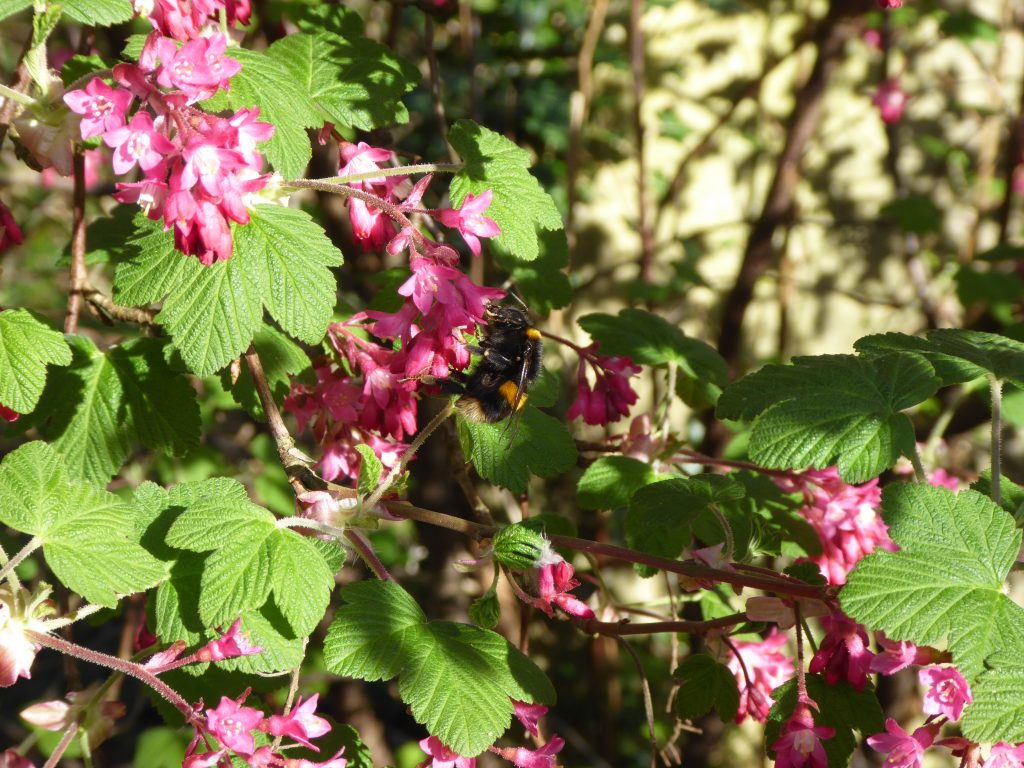
Buff-tailed Bumblebee, Bombus terrestris, queen

Later in the year Flowering Currant has strings of berries, rather like its Redcurrant and Blackcurrant relatives. These are edible but not enjoyable. The Plants for a Future website damns them with faint praise: “not … a wonderful flavour, but … tolerable raw”. Apparently, they “can be harvested when still firm in August and when stored carefully will keep until November, by which time the flavour has improved slightly”.

I leave the berries on mine for the birds. Blackbirds’ appetite for the berries is probably one reason why the plant now occurs widely in the countryside.

Notes

Note 1 – In the wild, there are two distinct forms of Ribes sanguineum: var. sanguineum and var. glutinosum. The differences are listed on the Flora of North America website as:

  • Racemes 5-15(-20)-flowered, erect to stiffly spreading or ascending; sepals red – var. sanguineum.
  • Racemes 15-40-flowered, pendent; sepals pink to white – var. glutinosum.

The plant was first described by Archibald Menzies in 1793, and was introduced into Britain in the early 19th Century (1826, according to the Online Atlas, or 1817, according to Paghat). They were known from the wild by 1916.

Note 2 – Stace (New Flora of the British Isles, Fourth Edition, 2019) lists eight species of Ribes growing wild in the British Isles.

  1. Ribes rubrum (Redcurrant) – probably native but also found as a garden escape.
  2. Ribes spicatum (Downy Currant) – native and local in woods on limestone from Lancashire and Yorkshire north to Caithness.
  3. Ribes nigrum (Blackcurrant) – Neophyte / naturalised.
  4. Ribes sanguineum (Flowering Currant) – Neophyte / naturalised.
  5. Ribes odoratum (Buffalo Currant) – Neophyte / naturalised survivor.
  6. Ribes alpinum (Mountain Currant) – Native in limestone woods in Northern England; escape elsewhere
  7. Ribes uva-crispa (Gooseberry) – Neophyte / naturalised.
  8. Ribes divaricatum (Coast Gooseberry) – Neophyte / naturalised survivor.

I have seen 1, 3, 4 and 7 growing in the wild.

Note 3 – Much of my information on different Ribes cultivars and species in the garden comes from the article “Currant Affairs” by Louise Curley, in the March 2017 edition of “The English Garden“.

(I keep a stash of these magazines in the summerhouse at the bottom of our garden for browsing from time to time with a cup of tea. My wife Vanna refers to them as my “garden porn”.)

Note 4 – See the American Phytopathological Society website for more details.
Posted in Edible, Ornamental | Tagged Blood Currant, Flowering Currant, Ribes, Ribes sanguineum

Barren Strawberry, Potentilla sterilis

Jeremy Bartlett's LET IT GROW blog Posted on 24 February, 2020 by Jeremy Bartlett24 February, 2020
Barren Strawberry, Potentilla sterilis

Barren Strawberry, Potentilla sterilis

The Barren Strawberry, Potentilla sterilis, is one of the first flowers of spring and can be in flower as early as February, especially in a mild winter like this one, though in cooler areas it will flower into May. The nearest plants are in my local cemetery, where it grows in the rougher grassy areas beneath trees. This is its usual habitat, though it will grow out in the open in upland areas. The plant can also be found on walls and in rock crevices.

Like Wild Strawberry (Fragaria vesca), which I wrote about last June, Barren Strawberry is a low-growing perennial and a member of the Rosaceae (the Rose family). Both plants have attractive white flowers.

Although the plants are superficially similar, there are a number of differences between Wild and Barren Strawberries.

Wild Strawberry flowers later in the year than Barren Strawberry (April to July, rather than February to May). Barren Strawberry has more widely spaced petals than Wild Strawberry and these are notched, and the sharply pointed green sepals extend at least as far as, or further than, the petal tips. Wild Strawberry has bright green, shiny leaves but those of Barren Strawberry are dull, grey-green with spreading hairs and smaller, with less prominent veins. Each Wild Strawberry leaflet tapers to a point but the terminal tooth on each Barren Strawberry leaflet is shorter than those on either side, giving it a more rounded appearance.

The ‘barren’ in Barren Strawberry and the plant’s specific name, sterilis, give a key difference from the Wild Strawberry: its fruits are not edible so there is no point in waiting for any red strawberries to form.

The fruit in both Barren and Wild Strawberries is an achene, a dry fruit which contains the seed. But in the Wild Strawberry the receptacle swells to produce an edible accessory fruit, the strawberry that we know and love. In Barren Strawberry the receptacle doesn’t swell and we are left with a small, dry and hard fruit, to the disappointment of foragers.

Potentilla sterilis is widely distributed in the British Isles. It is native here and throughout  much of the rest of Europe (Albania, Austria, Belgium, Czechoslovakia, Denmark, France, Germany, Italy, Netherlands, , Poland, Portugal, Spain, Sweden and Switzerland). It is also listed as “doubtfully present” in the North Caucasus and former Yugoslavia. Barren Strawberry has been introduced into Newfoundland in North America, where it is known as the Strawberryleaf Cinquefoil.

Clive Stace lists 16 species of Cinquefoils (Potentilla) in his “New Flora of the British Isles” (Fourth Edition 2019). Potentilla means “powerful, despite its small size” or “little powerful one” and is derived from the Latin word potens and French potence, which both mean “strong”, “powerful”, “mighty”, or “potent”. This is a reference to the claimed medicinal value of some plants in this genus.

British relatives of Barren Strawberry include Silverweed (Potentilla anserina; edible root and young leaves, astringent), Tormentil (Potentilla erecta;  astringent, folk medicine for diarrhoea) and Creeping Cinquefoil (Potentilla reptans; edible young leaves, antispasmodic and astringent). These three plants have yellow petals but others, such as Rock Cinquefoil, Potentilla rupestris, have white petals. The Shrubby Cinquefoil, formerly Potentilla fruticosa, widely grown as a garden shrub and found growing wild the British Isles in a Cumbria and Upper Teesdale in Northern England and in parts of Western Ireland, has been reclassified as Dasiphora fruticosa. The wild form has yellow petals but garden cultivars can also have white or orange flowers.

In grassland, Barren Strawberry becomes much more difficult to find once it has finished flowering, as the grass grows above the plant, making it more or less invisible. By late summer, the plant is but a distant memory, until spring arrives and the flowers open once more.

Posted in General, Ornamental | Tagged Barren Strawberry, Potentilla sterilis, Rosaceae, Strawberryleaf Cinquefoil

Post navigation

← Previous Post
Next Post→
Want to read more? Here is a full list of my blog posts.

Subscribe to Blog via Email

Enter your email address to subscribe to this blog and receive notifications of new posts by email.

Thirty latest posts

  • Fairy Foxglove, Erinus alpinus 27 February, 2026
  • Dwarf Thistle, Cirsium acaule 10 January, 2026
  • Zythia resinae (aka Sarea resinae) 30 December, 2025
  • Golden Conecap, Conocybe aurea 20 November, 2025
  • Five Fungi from Sweet Briar Marshes 23 October, 2025
  • Steccherinum oreophilum (aka Irpex oreophilus) – new for Norfolk 27 September, 2025
  • Orpine, Hylotelephium telephium 29 August, 2025
  • Wild Marjoram, Origanum vulgare 19 July, 2025
  • Goldilocks Buttercup, Ranunculus auricomus 5 June, 2025
  • Tree Lupin, Lupinus arboreus 28 May, 2025
  • American Skunk-cabbage, Lysichiton americanus 21 April, 2025
  • Cedar Cup, Geopora sumneriana 16 March, 2025
  • Cinnamon Bracket, Hapalopilus nidulans 13 February, 2025
  • Common Ragwort, Jacobaea vulgaris 13 January, 2025
  • Holly, Ilex aquifolium 7 December, 2024
  • Yellow Bird’s-nest, Hypopitys monotropa 24 November, 2024
  • Whiskery Milkcap, Lactarius mairei 8 November, 2024
  • Shaggy Bracket, Inonotus hispidus 25 September, 2024
  • Small Teasel, Dipsacus pilosus 24 August, 2024
  • Rothole Inkcap, Coprinopsis alnivora 1 August, 2024
  • Twinflower, Linnaea borealis 20 July, 2024
  • Foxglove, Digitalis purpurea 10 June, 2024
  • Beaked Hawk’s-beard, Crepis vesicaria 15 May, 2024
  • Thrift, Armeria maritima 17 April, 2024
  • Japanese Kerria, Kerria japonica 29 March, 2024
  • Golden Bootleg, Phaeolepiota aurea 12 March, 2024
  • Arched Earthstar, Geastrum fornicatum 22 February, 2024
  • Basil Thyme, Clinopodium acinos 3 January, 2024
  • Five Fungi from the Lanes of Norfolk 9 December, 2023
  • Five Fungi from the Streets of Norwich 21 November, 2023


All my posts

Complete list of blog posts


Select by date


Select by category

Site content copyright © 2012 - 2025 Jeremy Bartlett.
↑