↓
 

@jeremybartlett.bsky.social

Generic selectors
Exact matches only
Search in title
Search in content
Post Type Selectors
Filter by Categories
Edible
Foraging
Fungi
General
Ornamental
Poisonous

Jeremy Bartlett's LET IT GROW blog

The wonder of plants and fungi.

Jeremy Bartlett's Let It Grow Blog
  • Homepage
  • About Let It Grow
  • Contact Me
  • All My Posts
"People from a planet without flowers would think we must be mad with joy the whole time to have such things about us." - Iris Murdoch

Post navigation

← Previous Post
Next Post→

Cinnamon Bracket, Hapalopilus nidulans

Jeremy Bartlett's LET IT GROW blog Posted on 13 February, 2025 by Jeremy Bartlett14 February, 2025

I like distinctive, easy to identify fungi. One of these is the Cinnamon Bracket, Hapalopilus nidulans. 

(Cinnamon Bracket is also known by its synonym, Hapalopilus rutilans, but I am using Hapalopilus nidulans because it is the name currently being used by the British Mycological Society.)

Cinnamon Bracket, Hapalopilus rutilans

Cinnamon Bracket, Hapalopilus nidulans, on a decaying Hazel branch.  January 2025.

“An easily overlooked, unexciting fungus”

You might not think Cinnamon Bracket was distinctive, as it isn’t one of our larger, more impressive species of fungi.

Cinnamon Bracket has a small, fan-shaped to semicircular annual fruitbody no more than 2 – 12 cm (0.8 – 4.7 inches) in diameter, which attaches without a stalk to its substrate, a small log or stick.

Hapalopilus nidulans has an ochraceous to cinnamon brown top that becomes pinkish brown with age, while on the underside the thin-walled angular pores (2 – 4 per millimetre) are the same colour as the top.

To some Cinnamon Bracket is “an easily overlooked, unexciting fungus” but to those of us who appreciate nature’s subtleties it “stops you in your tracks during a woodland walk. Its warm, cinnamon-brown colour and soft, velvety texture make it stand out against the dull greys and greens of decaying wood“.

There is usually a distinct sterile margin around the pores, as in the photograph below.

Underside of Cinnamon Bracket, Hapalopilus rutilans, showing pores.

The underside of a Cinnamon Bracket, Hapalopilus nidulans, showing the pores and sterile margin. October 2022.

Cinnamon Bracket causes a white rot, breaking down lignin, cellulose and hemicellulose. In Europe it usually grows on hardwood species. In Northern Europe the main hosts are Hazel (Corylus avellana) and Sorbus (such as Rowan, Sorbus aucuparia), while in Central europe oaks (Quercus) are the commonest host trees. Hazel is the commonest host in the British Isles.

Hapalopilus nidulans is widespread in Europe as far north as Norway and also occurs in North Africa, Asia, North America and on mountains in tropical Africa (note 1). It has also been recorded from Australia and Oceania. Unusually, it is usually found on conifer debris in south-western parts of North America.

Underside of Cinnamon Bracket, Hapalopilus rutilans.

Underside of Cinnamon Bracket, Hapalopilus nidulans, showing pores. this specimen only has a small sterile margin.

I’ve seen Hapalopilus nidulans twice. There are 61 Norfolk record of Hapalopilus nidulans up to the end of 2024, from August to February, and most of these have been on Sorbus, Corylus, Quercus and Betula (birches). At the time of writing, there are 599 records on the NBN Atlas, mainly in England the northern half of Scotland.

Just add KOH

So far, fairly unexciting. But what makes Hapalopilus nidulans really distinctive is the chemical reaction when a drop of an alkaline solution, such as ammonia or potassium hydroxide (KOH), is added to its surface.

Where the alkali meets the fruitbody there is an instant colour change from pinkish brown to vibrant purple. Cinnamon Bracket is transformed from a small, subtle fungus into something truly memorable.

Jan Thornhill’s Weird and Wonderful Wild Mushrooms blog captures the excitement of the colour change: “When this otherwise boring fungus comes into contact with either ammonia or KOH, it immediately turns a psychedelic fuchsia (or cherry red in other parts of the world), a reaction that’s so magical and so spectacular it’s hard not to play with the effect over and over again” (note 2).

Underside of Cinnamon Bracket, Hapalopilus rutilans.

The underside of a Cinnamon Bracket, Hapalopilus nidulans, goes purple when treated with potassium hydroxide solution.

Polyporic Acid

Hapalopilus nidulans contains large quantities of polyporic acid (from 20 to 40% by weight) and it is this which reacts with an alkali to give the purple colour (note 3). 

Most polypore mushrooms are non-toxic and some (such as Chicken of the Woods) are edible and delicious but please don’t eat Cinnamon Bracket, as polyporic acid is toxic to mammals, including humans.

Polyporic acid (2,5-dihydroxy-3,6-diphenylcyclohexa-2,5-diene-1,4-dione) messes up RNA synthesis, specifically the manufacture of uracil, one of the nucleotide bases that form RNA. It does this by inhibiting the enzyme dihydroorotate dehydrogenase, which catalyses the synthesis of orotic acid, which is used to make uracil.

Polyporic acid damages the nervous system, liver and kidneys and eating a Cinnamon Bracket will lead to gastrointestinal distress, blurry vision, inability to balance, loss of kidney function, and purple urine. (The latter would be an impressive party trick but please don’t try this at home!)

The symptoms of poisoning begin about twelve hours after ingestion and can persist for a few days, but usually clear up within a week (note 4).

Polyporic acid also has anti-fungal and anti-bacterial properties and is found in several other species of fungi. Some of these are only distant relatives and the ability to produce polyporic acid is thought to have arisen independently three or four times.

Purple Dye

A safer and more practical use of Cinnamon Bracket is as a source of a lovely purple dye.

Thomas Roehl says (on the Fungus Fact Friday website) that Hapalopilus nidulans works very well as a dye for wool:

“To use this mushroom for dyeing, break it up into small pieces and place it in hot water with pre-mordanted wool. Then use ammonia to adjust the pH up to 9. The ammonia turns the mushroom purple. That color leaves the mushroom and adheres to the wool, turning it anywhere from a deep purple to a bright lavender. You normally use a 1:1 dry weight ratio of mushroom to wool, but H. nidulans is a strong dyer and you can probably use less. This is good, since H. nidulans is a fairly uncommon mushroom.”

Ann on the Shroomworks website (“Hapalopilus, Ever Abundant“, June 2018) gives more practical advice for dyeing with Hapalopilus nidulans and shares the results, some beautifully coloured balls of wool. She confirms that a small amount of the fungus goes a long way and has used a 150 gramme (5.2 oz) sample from Sweden about thirty times.

Jenny Dean also writes about dyeing with Hapalopilus nidulans (“South Downs Yarn & colours from fungi“) and the North American Mycological Association website gives details of this and other fungi that can be used for dyeing (“A Short Selection of the Best Mushrooms for Color“). This article also mentions Inonotus hispidus (Shaggy Bracket), which I wrote about a few months ago, not realising it could be used for dyeing.

I found my second Cinnamon Bracket a month ago in woodland to the west of Norwich while on a bike ride with my wife Vanna. I was pretty sure what it was but hadn’t taken my bottle of KOH out on my bike ride, so I took it home to check (note 5).

I’ve dried the bracket and passed it to my friend Sarah, who dyes fabrics. I hope to see the results soon and, if the dyeing is successful, I’ll share the results.

Other Names for Cinnamon Bracket

In Welsh, Cinnamon Bracket is Ysgwydd Sinamwn. Other English names for Hapalopilus nidulans (used in the United States) include Purple Dye Polypore and Tender Nesting Polypore. The specific name nidulans means “nesting”; rutilans is “orange-red” in Latin. Hapalopilus is from Ancient Greek, meaning “tender cap”.

Possible Confusion: Beefsteak Fungus

I think Cinnamon Bracket is pretty distinctive, even without the help of KOH, but a novice might possibly think that Hapalopilus nidulans was a very small Beefsteak Fungus (Fistulina hepatica) and indeed a 2013 poisoning by Hapalopilus nidulans occurred when someone mistook a Cinnamon Bracket for a Beefsteak Fungus.

Unlike a Beefsteak Fungus, Cinnamon Bracket never “bleeds” or reaches the size of a mature Beefsteak. The pores of Fistulina hepatica are straw-yellow, becoming reddish-brown as the fruiting body ages and unlike Hapalopilus rutilans they bruise deep red-brown. Fistulina hepatica is mainly found on oaks and Sweet Chestnut (Castanea sativa) in late summer and autumn, from August to October.

Beefsteak Fungus, Fistulina hepatica

Beefsteak Fungus, Fistulina hepatica. This one is “bleeding” slightly.

Unlike Cinnamon Bracket, the Beefsteak Fungus is edible, though mainly for the novelty of eating a fungus that looks like raw meat or liver. It can be consumed raw or cooked. I cooked it once and found it pleasant enough and would eat it again, though it was a bit acidic and lacked the balance of flavours that makes Chicken of the Woods so enjoyable. I agree with the First Nature website: “as an edible species it does not really live up to its good looks” (note 6).

Beefsteak Fungus, Fistulina hepatica

Beefsteak Fungus, Fistulina hepatica. “Edible, though mainly for the novelty of eating a fungus that looks like raw meat or liver”.

Top surface of Cinnamon Bracket, Hapalopilus rutilans

In contrast to a Beefsteak Fungus: The top surface of Cinnamon Bracket, Hapalopilus nidulans.

Notes

Note 1 – In “Poroid Fungi of Europe” Ryvarden and Melo use the name Hapalopilus rutilans.

They list its hardwood hosts as Acer, Aesculus, Alnus, Betula, Carpinus, Corylus, Crataegus, Fagus, Ficus, Fraxinus, Malus, Pittosporum, Populus, Prunus, Quercus, Robinia, Sambucus, Salix, Sorbus and Tilia. It occasionally grows on conifers such as Abies, Picea and Pinus. Pages 182 – 183, L. Ryvarden & I. Melo (2022). ‘Poroid Fungi of Europe’. 3rd edition. Fungiflora, Oslo, Norway.

Note 2 – In “Poroid Fungi of Europe” Ryvarden and Melo give the colour with KOH as “a vivid violet”. This is what I’ve found when I’ve treated specimens with KOH, as shown in my photograph above.

However, Michael W. Beug (in “Polyporic Acid in Fungi: A Brief Note“) says that “Ko, Jung and Ryvarden (2001) give the reaction between Hapalopilus nidulans and KOH as strongly cherry red, though North American collections give a lilac to violet reaction”. (See Ko, K.S., H.S. Jung and Lief Ryvarden (2001). “Phylogenetic relationships of Hapalopilus and related genera inferred from mitochondrial and small subunit ribosomal DNA sequences.” Mycologia Vol 93(2): pp 270 – 276.)

Note 3 – Michael W. Beug (in “Polyporic Acid in Fungi: A Brief Note“) speculates that the colour change “is the result of an acid-base reaction and that any base would produce the color change by removing an acidic proton” and this is the best explanation I have found. Please let me know if you find more details of this chemical reaction.

Not all colour changes with KOH are caused by polyporic acid. For example, the Hoof Fungus (Fomes fomentarius) goes dark blood red when a drop of KOH is added to a piece of tissue from the upper surface but this is due to the presence of fomentariol, a benzotropolone. (Arpin, N., J. Favre-Bonvin, W. Steglich  (1974): “Fomentarol: A New Benzo Tropolone Isolated From Fomes fomentarius“. Phytochemistry Vol. 13 (9), pp1949 – 1952).

The paper “Pigments of Higher Fungi: A Review” is worth a read if you want to know more about the many pigments that occur in the colourful kingdom of fungi.  J. Velisek & K. Cejpek (2011), Czech Journal of Food Sciences Vol. 29(2), pp87 – 102.

Note 4 – On the Weird and Wonderful Mushrooms website Jan Thornhill gives more details of Hapalopilus nidulans poisoning:

“The few cases of poisonings on record, including one adult and two children in the late Eighties, and a father and daughter a couple of years ago, (the latter incident involving the consumption of H. nidulans after misidentifying it as the “beefsteak fungus,” Fistulina hepatica), have all been similar in their descriptions of signs and symptoms that happen after a delay of at least 12 hours, the results of dysregulation of central nervous system functions and liver and kidney dysfunction:

  • abdominal pain
  • nausea and vomiting
  • headache
  • visual disturbances, including double vision, blurred vision, hallucinations
  • multidirectional involuntary eye movements
  • balance disorders 
  • general weakness
  • loss of appetite
  • signs of liver and kidney failure
  • and violet-coloured urine“.

The Jungle Dragon website mentions two poisoning cases – presumably the same ones – reported in 1992 (a family of three in Germany) and 2013. In both cases the symptoms started about 12 hours after ingestion and consisted of nausea, impaired movement, visual impairment, liver and kidney failure. The patients’ urine was purple. Everyone involved had recovered fully a week later.

Note 5 – We found a few other fungi here, including Spring Hazelcup (Encoelia furfuracea), Alder Scalycap (Pholiota alnicola) and Blushing Bracket (Daedaleopsis confragosa).

I would ideally have tested the bracket with KOH in the field, leaving it as a habitat for small invertebrates such as beetles.

Note 6 – Most wild fungi should be cooked before eating. Beefsteak Fungus is one of the few that is safe to eat when raw. Chicken of the Woods, in contrast, must be cooked and you should it eat with caution the first time you try it, as it can cause gastric upsets in some people.

Posted in Fungi, Poisonous | Tagged Beefsteak Fungus, Cinnamon Bracket, Fistulina hepatica, Hapalopilus nidulans, Hapalopilus rutilans

Common Ragwort, Jacobaea vulgaris

Jeremy Bartlett's LET IT GROW blog Posted on 13 January, 2025 by Jeremy Bartlett16 January, 2025
Common Ragwort, Senecio jacobaea

A glorious sight: summer skies and Common Ragwort, Jacobaea vulgaris.

Summer Glory

Memories of glorious summer flowers can brighten up the coldest, darkest winter day.

Today I am thinking about Common Ragwort, Jacobaea vulgaris, which bathes the countryside in its golden flowers in July and August and provides sustenance for many different insects, as well as food for the soul.

Ragwort with Small Tortoiseshell

Small Tortoiseshell butterfly on Common Ragwort (with Episyrphus balteatus hoverfly).

Common Ragwort, Jacobaea vulgaris is a native of the British Isles and is indeed common, found in almost every 10km square in England, Scotland, Wales and Ireland, from the Channel Islands in the south to Shetland in the north, up to a height of 1,020 metres above sea level.It is a member of the Asteraceae (Daisy family) and is one of five species of Jacobaea found in in the wild in the British Isles.

Jacobaea vulgaris is so familiar that it is often referred to simply as “Ragwort”, but many of its relatives in the genera Senecio and Jacobaea have English names featuring the word “Ragwort” (note 1).

Where Common Ragwort Grows

Common Ragwort can be found on waste ground, road verges and waysides, on rocks, screes and walls, on sand dunes, in scrub, open woods and along woodland rides. It particularly favours grasslands that are neglected, rabbit-infested or overgrazed.

Outside the British Isles, it is a native plant throughout Europe and in temperate parts of Asia, as far east as Mongolia and parts of China.

Jacobaea vulgaris has been introduced into parts of North America and Australia, parts of North Africa and New Zealand. In North America, it is known as Tansy Ragwort and is thought to have been introduced into Canada in the 1850s in ships’ ballast.

Like several other introduced plants, Common Ragwort is a bit too successful in its new home. (See, for example, my blog post on Shining Crane’s-bill from May 2023.) It is classed as a noxious weed in Australia, New Zealand and Canada and is on the Washington State Department of Agriculture’s prohibited plants list.

Heriades truncorum

A female Large-headed Resin Bee, Heriades truncorum. She collects her pollen and nectar from yellow Asteraceae, especially Common Ragwort. (Photo: Vanna Bartlett.)

How Common Ragwort Grows

Jacobaea vulgaris starts to flower in June and can continue flowering until at least October. Even a couple of weeks ago I found a couple of Ragwort plants in flower while doing a New Year Plant Hunt.

The peak of Ragwort’s flowering season is July and August and it provides a vital supply of nectar and pollen for many of the insects that also peak at this time of year. The feast day of St. James is celebrated on 25 July, and the generic name Jacobaea is named after St. James (Latin Jacobus). One of the English names of Common Ragwort is St. James’ Wort (note 2).

Common Ragwort is a biennial or short-lived perennial. Plants take two or more years to flower, forming a rosette of leaves in their early years. Many of the plants are monocarpic, forming seed and dying after flowering, but some regenerate and flower again in subsequent years, especially where the plant has been damaged or cut, or where the soil is poor (note 3).

Jacobaea vulgaris normally grows about a metre (three feet) in height but can reach 1.5 metres (five feet) tall. Its leaves are deeply pinnately lobed and their ragged shape has led to the name of “Ragwort”. The Wild Flower Finder website describes the leaves as “often reminiscent of the shape of a toilet brush“. It has some lovely photographs of the plant at different stages of growth, as do the Flora of East Anglia and Irish Wildflowers websites. (The Irish name, Buchalan Bui, means “Yellow Boy”.)

After flowering, a Common Ragwort plant produces seeds, each one consisting of an achene with an attached pappus (from Latin pappus, meaning “old man”). This forms a parachute that allows the seed to drift in the wind. The name Senecio is derived from senex (“old man”), after the white fluffy seeds.

The largest Ragwort plants have the most seed, with a few hundred seeds produced by smaller plants and thousands from the largest (note 4).

Common Ragwort seeds that don’t germinate straightaway in autumn or early winter can remain viable in the seed bank for up to 10 years, finally germinating if the soil is disturbed.

Churning up the ground by horses’ hooves will create perfect conditions for seed to germinate. Dry summers can benefit the plant too: at Knepp the drought in summer 2006 and in the following April led to masses of Common Ragwort flowers in 2008 (note 5).

On the Isle of May (in the entrance to the Firth of Forth in Scotland), a storm in December 2011 scorched off a lot of the vegetation with salt spray leaving lots of bare ground. Common Ragwort took advantage of the bare ground and flowered in large quantities in August 2013.

A Great Plant For Insects

Common Ragwort is a very important plant for insects and other invertebrates.

Small Copper on Ragwort

Small Copper butterfly obtaining nectar from Ragwort.

The charity Buglife compiled a list of 61 species of invertebrates (60 species of insect and one mite) that feed on Common Ragwort. Thirty of these species are completely reliant on the Common Ragwort and another 22 make major or significant use of the plant.

The Buglife list omits most of the species of pollinators and nectar feeders that visit the flowers. Adding insects visiting for nectar adds a further 117 species to the count.

The article “Focus on Ragwort” on the Bredfield village blog gives the figure that use Common Ragwort as a home and food source as “over 75 insect species in the UK and over half of these use it as their exclusive food source“.

The Ragwort Myths and Facts website says that “about 150 species of insects, such as bees, flies and butterflies, visit the plant“.

Regardless of the exact numbers of species that rely on it, Common Ragwort has a vital role in supporting Britain’s natural diversity at a time of serious decline.

Unpleasant Smell and Taste

Common Ragwort foliage has a distinctive smell when crushed and this has led to alternative names for the plant such as “Mare’s Fart” in North Shropshire and Cheshire and “Stinking Willie” in Scotland (note 2). Other variations include “Stinking Alisander”, “Stinking Billy”, “Stinking Davies”, “Stinking Nanny” and “Stinking Weed”.

The smell and taste are a warning: Common Ragwort contains toxins. These include at least eight pyrrolizidine alkaloids (jacobine, jaconine, jacozine, otosenine, retrorsine, seneciphylline, senecionine, and senkirkine). The alkaloids are secondary metabolites, compounds synthesised by plants as a defence mechanism against herbivores, insects and pathogens.

When eaten, pyrrolizidine alkaloids can be metabolised into highly reactive pyrrolic esters which can cause damage to liver cells and their DNA.

Concentrations of each pyrrolizidine alkaloid varies widely between plants depending on genetics and growing conditions and each alkaloid has a different level of toxicity.

Common Ragwort is by no means the only plant that contains pyrrolizidine alkaloids and it is estimated that around 6000 species of flowering plants contain these compounds, around 3% of all flowering plants. I’ve already written about a few of them, such as Viper’s Bugloss, Hemp Agrimony and Coltsfoot (note 6).

Ragwort and Humans

Common Ragwort presents no real danger to humans (or dogs for that matter), as its smell and bitter taste would repel even the most determined forager. The Wild Food UK website features Common Ragwort, but as a poisonous plant rather than recommended amuse-bouche.

As the Friends of the Earth Ragwort Mythbuster says “are you really going to eat plate-loads of ragwort any more than foxgloves or other poisonous plants that can be found in Britain’s fields or along paths and verges?”

Common Ragwort must be eaten to cause harm because pyrrolizidine alkaloids are only converted into pyrroles in the digestive system.

Common Ragwort plants can cause dermatitis when the plants are handled roughly or pulled up but this is caused by sesquiterpene lactones. These lactones are found in other plants as well, most frequently in members of the Asteraceae but in the Apiaceae (Carrot family) and Magnoliaceae (Magnolia family) too.

For this reason it is a good idea to wear gloves when handling or removing Common Ragwort. The stems are tough and fibrous to the touch and gloves also prevent abrasions.

Ragwort and Livestock

Common Ragwort is toxic to horses and cattle too, as are many other plants, but sheep and goats are much less affected.

However, I regularly see horses grazing happily amongst Common Ragwort, ignoring the plants entirely. Cattle normally avoid Common Ragwort plants too, unless stocking rates are particularly high (note 7).

As with humans, the smell and bitter taste of fresh Ragwort plants is normally off-putting, so animals choose other vegetation to eat. Because of the doses involved, even if a horse or cow eats an occasional small quantity of Common Ragwort it is unlikely to have a lasting effect on an animal’s health.


Conservation grazing - horse with Ragwort

This horse is grazing amongst Common Ragwort, showing no interest in the plant.

There is more of a problem is with dried (or wilted) Common Ragwort plants. These lose most of their off-putting smell and taste and livestock will happily eat hay containing Common Ragwort. For this reason Common Ragwort should be removed from fields where hay is going to be cut to feed livestock.

Owners of horses and cattle can minimise the risk of poisoning by avoiding overstocking and overgrazing and ensuring their animals have adequate food at all times. This is should be standard practice, as it is fundamental to the general welfare of the animals.

Briony Witherow writes on the Horse Hub website, “Key steps towards good pasture management include: Avoid over-stocking and overgrazing to minimise compaction, and give grass chance to ‘rest’. This should help to avoid bare patches that give weeds an opportunity to get established. Healthy soil and therefore healthy grass means less weeds”.

For the safety of their animals, many livestock owners remove Common Ragwort from their fields, but there is no need to remove Common Ragwort in places away from horses or cattle.

I think most horse owners would agree with John Shortland, who wrote on his blog  in July 2015: “So should ragwort be controlled or not?  The answer, as with most things in life, is yes but in moderation. It is quite unnecessary to remove ragwort plants from areas of low or no risk as is sometimes thought. I keep horses and spend time each year removing ragwort from the fields in which they graze.”

DEFRA (Department for Environment, Food & Rural Affairs) has a “Code of Practice on How to Prevent the Spread of Ragwort“, which splits land into three categories (note 8).

In the “Low Risk” category, “more than 100 metres from land used for grazing by horses and other animals or land used for feed/forage production”, no immediate action is required to control Ragwort and in uncultivated or semi-natural areas, “wherever possible uncultivated land with low levels of ragwort should remain undisturbed“.

Pyrrolizidine alkaloids and liver damage

Bacteria in an animal’s digestive tract break down some of the alkaloids in plants that it eats but some will travel to the liver. Here, some are metabolised into non-toxic compounds but others form highly reactive pyrrolic esters, which can cause damage to liver cells and their DNA.

The pyrrolizidine alkaloids don’t accumulate in the mammalian body and are excreted in 24 to 48 hours.

Small quantities of the alkaloids will cause small scale damage to the liver but as long as the damage is slight, healthy liver cells can take over the function of the damaged ones. In the longer term the liver has a unique capacity among the body’s organs to regenerate itself after damage.

Large quantities of pyrrolizidine alkaloids (between 5% and 25% of body weight for horses and cattle) can cause far more serious harm, in the form of an irreversible cirrhosis of the liver known as megalocytosis, where liver cells are larger than normal and have markedly enlarged nuclei. (This is because their ability to divide is impaired.)

As mentioned above, Common Ragwort is just one of the plants that contains pyrrolizidine alkaloids and the alkaloids are far from being the only cause of megalocytosis. 

Megalocytosis can also be caused by other toxins (such as aflatoxins, sometimes found in hay and grains), bacterial and viral infections, parasites  and birth defects.

This makes it very difficult to say with absolute confidence that the death of a horse from liver failure was actually caused by pyrrolizidine alkaloids and, if so, by Common Ragwort (note 9).

Deaths from Ragwort

How many livestock deaths are caused by Ragwort? We simply can’t tell.

As DEFRA’s “Code of Practice on How to Prevent the Spread of Ragwort” sums it up: “The scale and extent of illness and death in animals through ragwort poisoning is difficult to determine, as an autopsy would be required in every case to confirm the exact cause of death. There is no current test available to diagnose accurately whether an animal is suffering from ragwort poisoning, and certainly no test to help determine whether any such poisoning relates to ingestion of conserved or live ragwort.”

The number of deaths is probably very low. In June 2005 the Irish Minister for Agriculture and Food stated that “There are no official figures available in Ireland for deaths of horses due to ragwort poisoning. Unofficial estimates indicate that the level is very low and does not warrant any special attention or investigation.”

A report on the Animalweb website, “Ragwort toxicity in the UK (Defra Report 2014)” concludes: “The overall impression from… surveys is that ragwort is a very common weed but only a minority of horse owners spend significant time trying to control it. Despite this ragwort toxicity is an rarely encountered problem in UK horses subject to veterinary care.”

The Ragwort Facts website quotes UK government figures, which give a total number of 13 deaths in 2005 and ten deaths between 2005 and 2010. The website also mentions a French study which found 18 suspected and six confirmed cases in cattle over the period of a decade.

In contrast, the BSBI’s Fermanagh Species account for Jacobaea vulgaris tells us that “as many as 500 equines died from liver disease caused by Common Ragwort poisoning in 2001”. This figure can be traced back to 2003 when John Greenaway (MP for Ryedale) gave the figure in a parliamentary debate on the Equine Welfare (Ragwort Control) Bill. The numbers were “based on known or suspected cases, extrapolated for the whole country“.

Around the same time the British Horse Society claimed that 6500 British horses had died of Ragwort poisoning in 2002. Swansea Friends of the Earth quite rightly took issue with this figure and raised a complaint with the Advertising Standards Authority, which was upheld. (“Horse group told to tone down ragwort campaign”, the Mirror, June 2011.)

Thankfully, current information on the British Horse Society website is more balanced and matches DEFRA’s advice: “The BHS does not advocate blanket removal of all ragwort. The plant plays a significant role in biodiversity, providing a habitat and food for many types of insects, plus pollen for bees. Ragwort has an important place in the British ecosystem in areas away from horse grazing or land used for forage production and should only be removed from high-risk areas“.

There is certainly no need to force the unemployed to carry out unpaid work removing Common Ragwort, as was suggested by Lord Tebbitt in 2014 (note 10).

I think anti-Ragwort hysteria is less prevalent than ten or twenty years ago but every summer comments on social media revive some of the same old horror stories about Common Ragwort.

The “Ragwort, myths and facts” website (with advisors and authors based in the Netherlands, England and New Zealand) and the Ragwort Facts Website were created to counter these myths. The Ragwort Facts website gives a timeline for the campaign of mis-information about Common Ragwort.

Common Ragwort in the Garden

I don’t live anywhere near horses or other livestock so our garden is definitely a “Low Risk” area (note 8).

I am a great fan of Common Ragwort and have introduced it into our garden, where I can observe at close hand its importance for invertebrates. My plants self-seed and young plants appear in patches of bare soil near their parent but I can move or remove them when they’re growing somewhere I don’t want them. (Moving the plants is more successful in winter or early spring, if followed by a good watering to settle in the roots.)

When in flower, a single Common Ragwort makes a lovely statement plant.

Ragwort in the garden

Common Ragwort makes a lovely statement plant in our back garden.

Caterpillars of the Cinnabar moth, Tyria jacobaeae, feed on Common Ragwort and its close relatives from May to July. I have rescued them on a couple of occasions – from a meadow where Common Ragwort was being removed and from a grass verge in Norwich which had just been cut. I now have Cinnabar moth caterpillars in the garden every summer and have occasional sightings of the adult moths, which are mainly nocturnal.

Cinnabar moth caterpillars

Cinnabar moth caterpillars, Tyria jacobaeae, feeding on Common Ragwort leaves.

Common Ragwort brings me so much delight and, as a beautiful, native plant that supports so many insects, I think it is a terrible shame that it is subject to so much prejudice and misinformation.

I’ll let John Clare have the last word.

As Richard Mabey notes in his book “Weeds”, “Clare’s quiet praise of ragwort perhaps shows how far we have moved from an ecological understanding of weeds” (note 11).

“Ragwort, thou humble flower with tattered leaves
I love to see thee come & litter gold,
What time the summer binds her russet sheaves;
Decking rude spots in beauties manifold,
That without thee were dreary to behold,
Sunburnt and bare– the meadow bank, the baulk
That leads a wagon-way through mellow fields,
Rich with the tints that harvest’s plenty yields,
Browns of all hues; and everywhere I walk
Thy waste of shining blossoms richly shields
The sun tanned sward in splendid hues that burn
So bright & glaring that the very light
Of the rich sunshine doth to paleness turn
& seems but very shadows in thy sight.” – John Clare, “The Ragwort”(1831).

Common Ragwort Gallery

Some more photographs of insects enjoying Common Ragwort flowers:

Scotch Argus butterfly on Common Ragwort

Scotch Argus butterfly nectaring on Common Ragwort, Arnside Knott, Cumbria.

Mint Moth, Pyrausta aurata

Mint Moth, Pyrausta aurata, on Common Ragwort flowers.

White-letter Hairstreak butterfly nectaring on Common Ragwort

White-letter Hairstreak butterfly nectaring on Common Ragwort. Cranwich Camp, Norfolk.

Hairy-saddled Colletes, Colletes fodiens

A female Hairy-saddled Colletes, Colletes fodiens. She obtains her pollen from yellow Asteraceae, especially Common Ragwort.

Dusky Sallow moth, Eremobia ochroleuca

Dusky Sallow moth, Eremobia ochroleuca, visiting Common Ragwort flowers. Iken, Suffolk.

Locust Blowfly, Stomorhina lunata and Honeybee

Locust Blowfly, Stomorhina lunata and Honeybee on Common Ragwort in our back garden.

Wood-carving Leafcutter Bee, Megacile ligniseca

Wood-carving Leafcutter Bee, Megachile ligniseca, on Common Ragwort in our back garden.

Forester moth, Adscita statices, on Common Ragwort.

Forester moth, Adscita statices, on Common Ragwort, Norfolk Brecks.

Tachinid fly Eriothrix rufomaculata

Tachinid fly Eriothrix rufomaculata on Common Ragwort.

Notes

Note 1 – The other species of Jacobaea are:

  • Silver Ragwort, Jacobaea maritima – introduced from the Mediterranean
  • Marsh Ragwort, Jacobaea aquatica – native in marshes and damp meadows and by streams
  • Hoary Ragwort, Jacobaea erucifolia – native in England and Wales in grassy places, on banks and field edges but a rare alien in Scotland
  • Fen Ragwort, Jacobaea paludosa – very rare native of fenland ditches, in Cambridgeshire.

There are also three Jacobaea hybrids in the British Isles.

For more details see Clive Stace’s “New Flora of the British Isles“ (Fourth Edition, 2019).

When I first learnt plant names, the Asteraceae was still known as the Compositae and Common Ragwort was known as Senecio jacobaea. 

The genus Senecio still exists and more than a dozen species of Senecio in the British Isles include “Ragwort” in their English names. These include plants such as Broad-leaved Ragwort (Senecio sarracenicus), which I wrote about on 14th September 2021. Other members of the genus are known as groundsels, including Groundsel (Senecio vulgaris), the familiar annual weed.

Note 2 – Richard Mabey, pp 375 – 376, “Flora Britannica”. Sinclair-Stevenson, 1996. See also the Plant Lore website.

Note 3 – Studies have shown that between 28 and 44 per cent of plants can re-flower.

“Poole & Cairns (1940), Schmidt (1972) and Forbes (1977) observed that 33%, 28% and 44% respectively of their flowering plants re-grew.”

The references are:

  • Forbes, J.C. (1977). Weed Research 17: 387-391.”Population flux and mortality in a ragwort (Senecio jacobaea L.) infestation.”
  • Poole, A.L. and Cairns, D. (1940). “Biological aspects of ragwort (Senecio jacobaea L.) control”. Department of Scientific and Industrial Research Bulletin No. 82, Government Printer, Wellington, New Zealand.
  • Schmidt, L. (1972). Weed Research 12: 37-45. “Biology and control of ragwort, Senecio jacobaea L. in Victoria, Australia.”

Note 4 – A 1957 study gave figures between 4,760 and 120,400 seeds from plants at eight different sites. The highest total of 174,230 seeds came from a third year plant that had been cut down to prevent it from flowering in its second year. Figures for seed production are generally rounded up and the figure of 150,000 to 200,000 seeds per plant is often quoted.

If every seed grew, our planet would be covered in Common Ragwort in a short space of time but in reality only a small fraction of the seeds produce new plants. Conditions must be favourable for germination, with enough light, not too wet and not too dry. Even seeds that germinate must land in a spot that has enough light and nutrients and it will have to compete with other plants for survival.

Although they are light and equipped with parachutes, most Common Ragwort seeds don’t travel particularly far. Only 0.5% of all seeds that a plant produces travel more than 25 metres and most travel only a few several metres from the parent plant.

The Ragwort Facts website has more data and references to the studies. The first (carried out in New Zealand) looked at the behaviour of around 57 million seeds. The second (conducted in Oregon in the United States) tracked 53,000 individual seeds.

In my own experience I have a single plant three metres away from its parent, with the rest a metre or less away, though these are informal observations rather than a proper scientific study.

Note 5 – Isabella Tree, “Wilding”, Picador, London (2018). Chapter 8, “Living with the Yellow Peril” gives a fascinating account of Common Ragwort at the Knepp rewilding project. The Knepp website’s Injurious “Weeds” Policy is worth a read too.

Note 6 – It is estimated that around 6000 species of flowering plants contain these compounds, around 3% of all flowering plants.

Pyrrolizidine alkaloids are particularly found in members of the Boraginaceae (such as Viper’s Bugloss), Fabaceae (mainly the African genus Crotalaria), and in other members of the Asteraceae.

For more about pyrrolizidine alkaloids, see Moreira R, Pereira DM, Valentão P, Andrade PB (2018). “Pyrrolizidine Alkaloids: Chemistry, Pharmacology, Toxicology and Food Safety.” Int J Mol Sci. 2018 Jun 5;19(6):1668

Note 7 – Where stocking levels are high (five cows per hectare and more) less dominant animals may eat plants that more dominant animals avoid, including as Jacobaea vulgaris. From “Deadly Daisies?” by Gordon Maxwell, on The Biologist website, which includes references.

Note 8 – DEFRA’s “Code of Practice on How to Prevent the Spread of Ragwort” splits land into three categories:

  • High Risk – “Ragwort is present and flowering/seeding within 50m of land used for grazing by horses and other animals or land used for feed/forage production”.
  • Medium Risk – “Ragwort is present within 50m to 100m of land used for grazing by horses and other animals or land used for feed/forage production”.
  • Low Risk – “Ragwort or the land on which it is present is more than 100m from land used for grazing by horses and other animals or land used for feed/forage production”.

Paul Sterry makes a good point when he says of the Code of Practice: “for me the document is oddly schizophrenic: at one turn it conjures up nightmare visions of dead and dying horses – hundreds of them – dropping like flies through ragwort poisoning; and at the other extreme it extols the virtues and value to wildlife of Senecio jacobaea. I may be wrong but it has all the hallmarks of a document written by committee, but a committee whose polarised members could not agree”. (“Guest blog – Ragwort: friend or foe? by Paul Sterry“, 9th July 2019).

The document’s introduction by Rt Hon Alun Michael MP (Minister of State for Rural Affairs and Local Environment Quality and Minister for the Horse) seems to confirm this impression: “The Code is very much a combined effort, reflecting upon the importance of balancing the variety of interests involved. It has been drawn up in consultation with a Steering Group comprising The British Horse Society, Network Rail, English Nature, Wildlife and Countryside Link, the British Beekeepers Association, ADAS and representatives of Local Government. I should like to thank the Group for its efforts. It has not been an easy task to reconcile the different interests and I am grateful for the co-operative spirit shown by the members of the Group“.

Note 9  – Liver failure has a long list of symptoms. These include weight loss, lack of appetite and energy, a dull coat, crusts (in horses, especially on the coronary band), photosensitation, jaundice, and neurological signs, such as staggering, walking in circles, inattentiveness, restlessness, and panicking behaviour. (A rarely used vernacular name for Common Ragwort is “Staggerwort”.)

Note 10 -“‘Make young unemployed pull up ragwort for benefits,’ says Lord Tebbit” is a Guardian headline from October 2014. Lord Tebbitt’s suggestion was, quite rightly, met with scorn. In an opinion piece later the same month, Harry Leslie Smith wrote that “Tebbit shows that Tory cruelty and prejudice run as deep as ragwort roots“. For strict accuracy I should point out that Common Ragwort roots don’t go especially deep.

Note 11 – Richard Mabey, “Weeds: The Story of Outlaw Plants” (2012). Revised paperback edition. Profile Books, London.
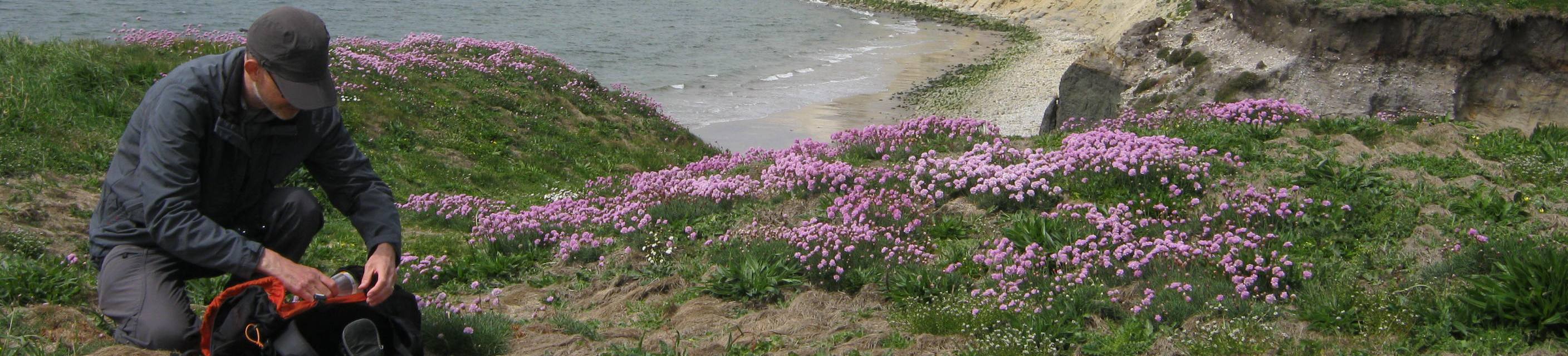
Posted in Ornamental, Poisonous | Tagged Common Ragwort, Jacobaea vulgaris, Ragwort

Holly, Ilex aquifolium

Jeremy Bartlett's LET IT GROW blog Posted on 7 December, 2024 by Jeremy Bartlett4 January, 2026
Holly, Ilex aquifolium

Holly, Ilex aquifolium

With Christmas approaching, I’ve decided to write about Holly, Ilex aquifolium.

In 2017 I wrote about Ivy, Hedera helix, Holly’s companion in the traditional carol “The Holly and the Ivy” and in 2015 I wrote about Mistletoe, Viscum album, that other favourite festive evergreen. But today it’s Holly’s turn at long last.

Holly, Ilex aquifolium, is a familiar native evergreen tree or shrub. It can exceed ten metres tall (30 feet) – The Trees and Shrubs Online website says “up to 80 ft high” – but more typically it reaches two or three metres (seven to ten feet) in height and spread. Its berries and glossy leaves, often adorned with spiny teeth, make it an attractive midwinter plant and it is often cut used as a Christmas decoration.

Holly in the British Isles

Holly is found almost throughout the British Isles, with a distribution spot in most ten kilometre squares in the BSBI Online Plant Atlas. The exceptions are some islands and upland areas, although Ilex aquifolium is able to grow at an altitude of 600 metres above sea level in the Lake District.

Holly In Gardens

Holly makes an adaptable garden plant. It is tolerant of industrial pollution and can be used for topiary, clipped into formal shapes, as at the National Trust’s Tyntesfield in Somerset. It makes a good hedge, either on its own or mixed with other species that cope with a regular trim, such as Beech (Fagus sylvatica) or a mixture of other wild species.

The Plant Atlas notes that widespread planting has completely obscured the native distribution of Ilex aquifolium and my nearest Holly has been planted in gardens and in the local cemetery.

Holly, Ilex aquifolium, in Earlham Cemetery, Norwich.

Holly, Ilex aquifolium, in Earlham Cemetery, Norwich.

Holly in Hedges

In the wider countryside, Holly grows in hedges and as isolated roadside trees, usually as the remnants of a hedge.

Holly, Ilex aquifolium

A roadside Holly, Ilex aquifolium, near Wymondham, Norfolk.

Why do Holly trees survive when the rest of the hedge has been removed?

In “Flora Britannica” Richard Mabey (note 1) mentions the widespread belief that cutting down a Holly tree will bring bad luck. This may have “a time-lag of as much as forty years” so is difficult to prove. On a more practical level perhaps the tree is considered useful. The outline of a Holly tree could be used as a useful landmark to fix on when ploughing a field in winter.

While it may be unlucky to remove a whole Holly tree, there is a long tradition of bringing cut branches indoors at Christmas and, before that, to celebrate the winter solstice. Holly branches also make nutritious and palatable forage for livestock and have often been cut for that purpose.

Thomas Hale was a fan of Holly hedges: “No hedge is so beautiful; none so strong. When well grown, it appears as a wall rather than a hedge, and is altogether impenetrable by cattle.” (note 2).

Holly at Staverton Thicks

One of my favourite places to see Holly is Staverton Park in Suffolk. A footpath from the main road winds through dark woodland (Staverton Thicks) where large Holly trees grow, sometimes sprouting upwards from fallen trunks.

Holly, Ilex aquifolium

Holly, Ilex aquifolium, at Staverton Thicks. Stems sprouting upwards from a fallen trunk.

At Staverton the Holly trees surround ancient oak trees and some have taken root high up in the oaks’ branches. Others over-top them and in “The History of the Countryside” Oliver Rackham describes how “over-shadowed giants moulder in the twilit shade or lean half-fallen against other giants” (note 3).

Holly, Ilex aquifolium

This Holly, Ilex aquifolium, has outgrown an old Oak tree at Staverton Thicks.

Further into the Park the path heads out of the Holly trees and on a sunny day the visitor emerges, blinking, to see an expanse of magnificent oaks growing out in the open amongst Bracken (Pteridium aquilinum) (note 4).

Holly Outside the British Isles

Ilex aquifolium is a member of the family Aquifoliaceae. The family contains just one genus, Ilex, of which there are over 570 species worldwide. The specific name aquifolium means “with pointed leaves”.

Outside the British Isles, Ilex aquifolium is native in other European countries (but extinct in Sweden) and in Morocco, Algeria and Tunisia. It typically grows in the shade of oak and Beech trees. Holly often grows in moist places but it can cope with summer drought as well as winter frosts. (The Royal Horticultural Society gives it a hardiness rating of H6, “hardy in all of UK and northern Europe (-20 to -15 Celsius)”.) Holly doesn’t like prolonged frosts or waterlogged soils.

Holly has been introduced into Turkey, Lebanon and Syria, parts of Canada and the United States and New Zealand and parts of Australia. In North America Holly can be very invasive, quickly spreading into native forests and crowding out native species.

Holly seems to be increasing in abundance at the eastern edge of its European range, as well as in eastern England.

Leaves and Berries

Holly is quite slow-growing in the British Isles and has a high tolerance for shade. Each leaf can stay on the plant for three to four years, saving the plant energy.

In a natural setting, where Holly’s lower leaves are prickly to deter browsing herbivores but leaves higher up the plant have fewer prickles. In addition, Holly can adapt to browsing by growing pricklier leaves.

Ilex aquifolium is a dioecious plant, with separate male and female trees. Female trees start to produce berries from about twenty years old. Each scarlet berry contains four seeds and some years are better for berry production than others. Traditionally a year with prolific Holly berries is said to warn of a harsh winter but more likely reason is that the spring lacked a late frost and there was plenty of sunshine in July.

Male Holly flowers

Male Holly flowers.

Some garden varieties of Ilex aquifolium are self-fertile (such as ‘J.C. van Tol’) and if you want berries from just the one tree, these are the best option. Beware that some cultivar names are rather confusing and Ilex aquifolium ‘Golden Queen’ is a male variety, while Ilex x altaclerensis ‘Golden King’ is female.

There are varieties of Holly with different shaped leaves and more or less prickles, either all green or variegated. The Gardeners’ World article “10 holly trees to grow” gives some examples. If you prefer yellow berries to the normal scarlet ones, varieties such as Ilex aquifolium ‘Bacciflava’ are available.

Birds such as Blackbirds and Mistle Thrushes enjoy Holly berries but the berries are mildly toxic to humans. Symptoms of poisoning include diarrhoea, vomiting and stupor, but only when consuming large quantities. The Plants for a Future site mentions using the leaves of Ilex aquifolium as a tea substitute and the related Ilex paraguariensis is used to make yerba-maté (note 5).

Holly and Wildlife

As well as eating the berries, birds appreciate the dense shelter that Holly provides and insects can use Holly’s protection too.

Only a small number of insects eat Holly leaves but the mines of the Holly Leaf-miner, Phytomyza ilicis (an Agromyzid fly) are found on practically all Holly trees, in my experience.

The Holly Tortrix moth, Rhopobota naevana, also feeds on Holly.

Holly Leaf-miner, Phytomyza ilicis

Mines of the Holly Leaf-miner, Phytomyza ilicis.

Holly flowers – remember, they are normally male and female on separate trees – are white and come in small bunches (note 6). They are produced from May to August and the flower buds, berries and terminal leaves are used as a foodplant by caterpillars of the spring brood of the Holly Blue butterfly, Celastrina argiolus. The summer brood of the butterfly uses Ivy, Hedera helix.

Both foodplants occur in churchyards and cemeteries, as well as in larger, established gardens, all of which are good places to look for the butterfly.

Holly Blue butterfly, Celastrina argiolus

Holly Blue butterfly, Celastrina argiolus

Mating Holly Blue butterflies, Celastrina argiolus

Mating Holly Blue butterflies, Celastrina argiolus.

Numbers of Holly Blues fluctuate from year to year. Holly Blue numbers are controlled by the butterfly’s parasite, the solitary wasp Listrodromus nycthemerus. 

Listrodromus nycthemerus

Listrodromus nycthemerus

Holly and Fungi

In mid-winter dead, fallen Holly leaves usually have a dark speckling on their upper surface, caused by Holly Speckle, Trochila ilicina. This fungus feeds on dead leaves rather than living Holly trees.

In 1989 Holly Leaf Blight, Phytophthora ilicis (note 7), was accidentally introduced into the British Isles from North America. It causes Holly leaves to blacken and drop. It is very disfiguring  but can be controlled, at least to some extent, by improving air flow around the plant and removal of diseased leaves and branches. I’ve seen it a few times in Norfolk in shady churchyards or damp woods but so far most Hollies seem unaffected.

Holly Blight, Phytophora ilicis

Holly Blight, Phytophora ilicis

The Holly Parachute, Marasmius hudsonii, is a scarce, near mythical tiny mushroom that grows on dead, moist Holly leaves. I have never seen it but the First Nature website has some lovely photographs. There are currently just two records of the fungus in Norfolk, at Swanton Novers in October 2003 and at Wheatfen in September 2005.

Holly Timber

Holly timber has a tendency to warp, so must be dried slowly and carefully. The wood is white and it is strong, resistant to impact and can be given a fine surface. It can be used as a veneer and is prized as an inlay by cabinet makers. It has been used for handles of tools and riding whips.

Holly also makes a good firewood because it has a high oil content and will burn when green as well as when seasoned (note 8).

Holly Place Names

“Flora Britannica” gives examples of several places in the British Isles named after Holly.

These include Hollington in Derbyshire, Hollingworth in Cheshire and, nearer to home, Hulver in Suffolk. (“Hulver” is the Middle English name for Holly.) Less obvious perhaps is Cullen on the Moray coast, said to be derived from the Gaelic  word for Holly (note 1).

In his book “The New Forest”, Colin Tubbs mentions that the cultivation of Holly as a fodder crop was widespread in England and Wales from the 13th to 18th centuries and probably before that too. Stands of Holly in the New Forest were known as “holms” and “hats” and these words survive in names such as Standing Hat and Holm Hill. In the Pennines, Cumbria and Welsh Marches Holly has resulted in a number of “hollin” place names (note 9). Richard Mabey gives examples such as Hollinroyd (Holly clearing), Hollin Hall and Hollingreave Farm, as well as Hollington in Derbyshire and Hollingworth in Cheshire (note 1).

New Forest ponies love the nutritious, evergreen Holly, which forms an important part of their winter diet (note 9). They are able to bite off and chew whole stems of prickly gorse and Holly.

As you can see, Holly, like Ivy, isn’t just for Christmas.

Notes

Note 1 – Richard Mabey, pp 244 – 251, “Flora Britannica”. Sinclair-Stevenson, 1996.

“Scottish Hill and Mountain Names” by Peter Drummond (Scottish Mountaineering Trust, 1992) gives “cuilionn” as the Gaelic word for Holly.

Note 2 – Quoted in John Wright, “A Natural History of the Hedgerow”. Profile Books, 2017.

Note 3 – Oliver Rackham, page 145, “The History of the Countryside”. J. M. Dent & Sons Ltd, London, 1986.

Note 4 – One of these trees held the Magpies’ treasure in the third series of “Detectorists“.

Note 5 – I tried yerba-maté a few years ago and I found it far too bitter and won’t bother to repeat the experience. I much prefer “proper” tea made with Camellia sinensis.

Note 6 – See the Wildflower Finder website for some lovely pictures of Holly, including its flowers.

Note 7 – Phytophthora ilicis is a type of oomycete. Oomycetes are filamentous eukaryotic organisms and are now considered to be Stramenopiles rather than fungi.

Note 8 – From pages 275 – 277 of “The New Sylva: A Discourse of Forest and Orchard Trees for the Twenty-First Century”  by Gabriel Hemery and Sarah Simblet (Bloomsbury, London, 2021).

Note 9 – Colin R. Tubbs, “The New Forest”. New Naturalist series, Collins, 1986.

Page 126: Studies of the diet of New Forest ponies showed a definite seasonal pattern, with grass forming most of their diet in May, June and July. Between September and May gorse, tree leaves and twigs (notably Holly), moss and heather were more important, along with Bracken fronds in August and September.

Posted in Ornamental | Tagged Holly, Ilex aquifolium

Post navigation

← Previous Post
Next Post→
Want to read more? Here is a full list of my blog posts.

Subscribe to Blog via Email

Enter your email address to subscribe to this blog and receive notifications of new posts by email.

Thirty latest posts

  • Fairy Foxglove, Erinus alpinus 27 February, 2026
  • Dwarf Thistle, Cirsium acaule 10 January, 2026
  • Zythia resinae (aka Sarea resinae) 30 December, 2025
  • Golden Conecap, Conocybe aurea 20 November, 2025
  • Five Fungi from Sweet Briar Marshes 23 October, 2025
  • Steccherinum oreophilum (aka Irpex oreophilus) – new for Norfolk 27 September, 2025
  • Orpine, Hylotelephium telephium 29 August, 2025
  • Wild Marjoram, Origanum vulgare 19 July, 2025
  • Goldilocks Buttercup, Ranunculus auricomus 5 June, 2025
  • Tree Lupin, Lupinus arboreus 28 May, 2025
  • American Skunk-cabbage, Lysichiton americanus 21 April, 2025
  • Cedar Cup, Geopora sumneriana 16 March, 2025
  • Cinnamon Bracket, Hapalopilus nidulans 13 February, 2025
  • Common Ragwort, Jacobaea vulgaris 13 January, 2025
  • Holly, Ilex aquifolium 7 December, 2024
  • Yellow Bird’s-nest, Hypopitys monotropa 24 November, 2024
  • Whiskery Milkcap, Lactarius mairei 8 November, 2024
  • Shaggy Bracket, Inonotus hispidus 25 September, 2024
  • Small Teasel, Dipsacus pilosus 24 August, 2024
  • Rothole Inkcap, Coprinopsis alnivora 1 August, 2024
  • Twinflower, Linnaea borealis 20 July, 2024
  • Foxglove, Digitalis purpurea 10 June, 2024
  • Beaked Hawk’s-beard, Crepis vesicaria 15 May, 2024
  • Thrift, Armeria maritima 17 April, 2024
  • Japanese Kerria, Kerria japonica 29 March, 2024
  • Golden Bootleg, Phaeolepiota aurea 12 March, 2024
  • Arched Earthstar, Geastrum fornicatum 22 February, 2024
  • Basil Thyme, Clinopodium acinos 3 January, 2024
  • Five Fungi from the Lanes of Norfolk 9 December, 2023
  • Five Fungi from the Streets of Norwich 21 November, 2023


All my posts

Complete list of blog posts


Select by date


Select by category

Site content copyright © 2012 - 2025 Jeremy Bartlett.
↑