↓
 

@jeremybartlett.bsky.social

Generic selectors
Exact matches only
Search in title
Search in content
Post Type Selectors
Filter by Categories
Edible
Foraging
Fungi
General
Ornamental
Poisonous

Jeremy Bartlett's LET IT GROW blog

The wonder of plants and fungi.

Jeremy Bartlett's Let It Grow Blog
  • Homepage
  • About Let It Grow
  • Contact Me
  • All My Posts
"People from a planet without flowers would think we must be mad with joy the whole time to have such things about us." - Iris Murdoch

Post navigation

← Previous Post
Next Post→

Foxglove, Digitalis purpurea

Jeremy Bartlett's LET IT GROW blog Posted on 10 June, 2024 by Jeremy Bartlett27 February, 2026

We’ve had a magnificent display of Foxgloves this year, after all the rain.

The Foxglove, Digitalis purpurea, is one of my favourite flowers and I can’t help smiling when I see one.

One Foxglove is lovely but a mass of Foxgloves is even better.

Foxgloves, Digitalis purpurea

Foxgloves, Digitalis purpurea, on our allotment. 3rd June 2024.

Digitalis purpurea is a biennial or short-lived perennial herb. It forms a sturdy rosette of leaves in its first year and then a tall flower spike in its second. The plant expends a lot of energy in flowering and often dies straightaway, but sometimes survives to flower less spectacularly the next summer. There is normally only one flower spike per plant but if the flowering stalk is damaged early in its growth, multiple flower spikes can form.

After flowering a Foxglove sets large amounts of seed and the seeds will germinate if there is bare soil and plenty of light, but when the conditions are unsuitable seeds can survive in the soil’s seed bank and produce plants in subsequent years.

Disturbance of the soil and opening up of a tree canopy can trigger a mass germination of Foxglove seeds and Foxgloves can be found in great abundance in disturbed or burnt areas, such as beside tracks and roads or in recently felled forestry plantations.

Digitalis purpurea occurs in nearly every 10km square in the British Isles. Foxgloves like acidic soils, but are a popular garden plant and many of the records in places with alkaline soils are probably garden escapes. The BSBI Plant Atlas lists Foxgloves’ habitats in the British Isles as on hedge banks, in open woods and woodland clearings, on heathland and moorland margins, riverbanks, montane rocky slopes, sea-cliffs, walls and waste land. They can grow quite happily on hillsides with Bracken (Pteridium aquilinum), rising above the fern’s green canopy (note 1).

The name “Foxglove” can be traced back to the Old English “foxes glofa“. The shape of the flower suggests the finger of a glove and, in “Flora Britannica” Richard Mabey suggests the “fox” part of the name comes from the plant’s habit of growing in “foxy places” (note 2). The name “Digitalis” comes from the Latin digitus (finger).

Foxgloves

Foxgloves, Digitalis purpurea, in Oaken Wood, Chiddingfold. 6th June 2018.

When I first studied plants Digitalis purpurea was a member of the family Scrophulariaceae but it was moved to the Veronicaceae in 2001 and nowadays it is considered to be in the Plantaginaceae (note 3).

Worldwide there are about 20 species of Digitalis, all native to Europe, western Asia and north-western Africa.

Digitalis purpurea is native to Belgium, Corsica, the Czech Republic and Slovakia, France, Germany, Great Britain, Ireland, Morocco, Portugal, Sardinia, Spain and Sweden. It has been introduced to many other parts of the world, including large parts of North and South America, several eastern European countries, New Zealand, Tasmania and Zimbabwe. Foxgloves feature in the Invasive Plant Atlas of the United States.

Foxgloves started to flower in mid May this year here in Norfolk but the main flowering period starts in early June. It can continue into September, depending on location. The flowers are a pinky-purple and have spots inside the flower tube. They attract bumblebees, particularly the Garden Bumblebee, Bombus hortorum, Buff-tailed Bumblebee, Bombus terrestris, and the Common Carder Bee, Bombus pascuorum.

Foxglove flowers close up

Foxglove flowers – close up.

White-flowered Foxgloves occur naturally and are often grown in gardens.

The Wild Flower Finder website has pictures of other variations of Foxglove flowers.

White Foxgloves

Also available in white. Foxglove, Digitalis purpurea.

A few weeks ago as I walked past a garden on the other side of our road I noticed a Foxglove with an unusual flower. Most of the flower spike was normal but the top flower was open to the skies and didn’t form the usual tube of fused petals.

This development is known as a terminal peloric flower. Peloric flowers are radially symmetrical flowers that occur in species which normally have flowers with bilateral symmetry.  “Terminal” refers to the flower’s position at the top of the flower spike. “Peloria” is from the Greek word for monster.

The Royal Botanic Gardens Kew website has an interesting article by Paula Rudall, “Weird and Wonderful Foxgloves”, which describes the phenomenon. Breeding experiments have shown that the terminal flower mutation in Digitalis is passed on to the plant’s offspring as a simple Mendelian recessive trait.

Terminal peloric Foxglove flower

Foxglove with a terminal peloric flower.

Terminal peloric Foxglove flower

Close up of the terminal peloric Foxglove flower.

Peloric flowers also can be found in other species which normally have bilateral flowers, such as mints, orchids and Snapdragon (Antirrhinum).

When I a PhD student at the John Innes Centre in the late 1980s, scientists were studying the cause of peloric flowers in Antirrhinum and a resulting scientific paper was published in the journal ‘Nature’ in 1996 as “Origin of Floral Asymmetry in Antirrhinum“.

Foxgloves

Foxgloves, St. Agnes, Isles of Scilly. 20th June 2010.

Foxgloves are poisonous but have a bitter taste so are not tempting to eat. If eaten, vomiting occurs before large amounts of toxins can be absorbed. Symptoms of poisoning include nausea, vomiting (sometimes for more than 24 hours), abdominal pain, diarrhoea, headache and a slow and irregular pulse. Cooking doesn’t destroy the toxins (note 4).

Historically Foxgloves were used as a purgative and the botanist John Parkinson said that they “purge the body both upwards and downwards” (cause diarrhoea and vomiting).

In the late 18th Century the English botanist and physician William Withering used extracts of Foxglove leaves to treat dropsy, an accumulation of fluid in soft tissues caused by a weakness of the heart (note 5). Dosage was critical and too much Foxglove leaf could stop the heart altogether. Withering insisted on using small, accurately measured amounts of dried Foxglove leaf and in his careful research was one of the founders of modern clinical pharmacology.

The active ingredients in Foxgloves are the cardiac glycosides digitoxin and digoxin and they are still widely used in medicine as heart stimulants. They are still extracted from Foxglove plants, but usually from species other than Digitalis purpurea (such as the southern European Digitalis lanata) (note 6).

Notes

Note 1 – The Wild Flower Finder website has a good picture of this.

Note 2 – Where you might find a Fox. Pages 332 – 333 of Richard Mabey’s “Flora Britannica” (Sinclair-Stevenson, 1996).

Note 3 – In Stace’s Flora Digitalis is part of the Veronicaceae. Page 618, “New Flora of the British Isles“ by Clive Stace, Fourth Edition, 2019.

Note 4 – From pages 74 – 75 of “Poisonous Plants and Fungi – An Illustrated Guide” by Marion Cooper and Anthony Johnson, HMSO, 1994.

Note 5 – Nowadays dropsy would be diagnosed as congestive heart failure – the inability of the heart to keep up with the demands on it.

William Withering may have learnt of the cure for dropsy from “an old woman in Shropshire” but the widely quoted story that “Mother Hutton”, a herbalist from Shropshire, sold William Withering the cure for dropsy is a myth invented by a pharmaceutical company for marketing purposes.

Note 6 – During the Second World War native Foxglove leaves were gathered in large quantities for medicinal use, as European plants were unavailable. The harvest was co-ordinated by the County Herb Committees. Careful drying was necessary to preserve the cardiac glycosides.

Posted in Ornamental, Poisonous | Tagged Digitalis purpurea, Foxglove

Beaked Hawk’s-beard, Crepis vesicaria

Jeremy Bartlett's LET IT GROW blog Posted on 15 May, 2024 by Jeremy Bartlett16 May, 2024

Beaked Hawk’s-beard, Crepis vesicaria, is in flower right now, in and around Norwich, its bright yellow flowers livening up grass verges and path edges.

I pass Beaked Hawk’s-beard on grass verges when I walk to the local shops. On Monday we found it by a gravel path on the Yare Valley Walk on the western edge of Norwich. Last week we cycled past a nice patch of it at Taverham when crossed the Norwich’s Northern Distributor Road (NDR) on the Marriott’s Way cycle path.

Beaked Hawksbeard, Crepis vesicaria

Beaked Hawk’s-beard, Crepis vesicaria. Marriott’s Way bridge, Taverham. 9th May 2024.

In the southern half of the British Isles Crepis vesicaria is “the earliest, leafy-stemmed branched dandelion-type to come into flower, very conspicuously, on May roadsides” (note 1). You can find it in flower in the British Isles from May to July.

Considering its abundance in southern Britain, you may be surprised to discover that Beaked Hawk’s-beard is a neophyte, a non-native plant introduced to the British Isles since 1492.

Crepis vesicaria was first recorded in Kent in 1713. It spread rapidly and by 1896 it had reached the west coast of Ireland. It continues to spread and is now well-established in north-east England and spreading in western England, Wales and Ireland. It has a limited distribution in Scotland – so far – perhaps limited by climate.

Crepis vesicaria is a member of the Daisy family, Asteraceae (formerly known as the Compositae) and each flower head is a composite structure consisting of lots of individual small flowers (florets) (note 2).

Beaked Hawk’s-beard is usually a biennial, flowering in its second year, but it does occasionally grow as an annual or perennial. In its first year it produces stalked, deeply lobed basal leaves covered in light down, which persist over winter. In its second year the plant sends up stems clasped by narrow leaves, which branch into multiple flowering stems, each topped with a yellow dandelion-type flower head. The outer ray florets of the flower have an orange-red stripe on the underside (note 3). If cut, the stems bleed bluish-white sap (note 1).

After flowering, Beaked Hawk’s-beard sets seed. Crepis vesicaria seeds have a narrow, elongated “beak” at the top, between the seed and the tuft of silky white hairs (pappus) that serves to distribute the seed in the wind. Hence the name “Beaked Hawk’s-beard” (sometimes spelt “Beaked Hawksbeard”).

There are great photos of Beaked Hawksbeard on the Wild Flower Finder website and Mike Crewe’s Flora of East Anglia has a page of Hawkweeds, Hawk’s-beards & Allies which are useful for comparing Crepis vesicaria with its relatives.

Beaked Hawksbeard, Crepis vesicaria

Beaked Hawk’s-beard, Crepis vesicaria. On a pathside in Norwich, 13th May 2024.

In the British Isles, Beaked Hawk’s-beard mainly grows in disturbed sites: on the verges of paths, tracks and roads, on railway banks, arable margins, set-aside, pavements, gardens, allotments, in waste places and in rough grassland, meadows, lawns and old pits.

Beaked Hawk’s-beard was introduced into Britain from the Mediterranean, probably as a contaminant of grass seed (note 4). It is a native of southern Europe, Turkey, and North Africa (Algeria, Morocco and Tunisia).

As well as the British Isles, Crepis vesicaria has been introduced into the United States (California, Connecticut, Hawaii, New York, North Carolina, Oregon and Pennsylvania), Canada (British Columbia) and Australia (South Australia and Victoria).

The Plants of the World Online website lists nine subspecies of Crepis vesicaria. Most British Beaked Hawk’s-beard plants are Crepis vesicaria subspecies taraxacifolia and have long beaks on all their achenes. But some plants from Cambridgeshire have outer achenes with very short beaks, provisionally making them subsp. stellata (note 5).

In the Norwich area, Beaked Hawk’s-beard is often attended by a solitary bee slightly smaller than a Honeybee, the Cat’s-ear Mining Bee, Andrena humilis.

Andrena humilis is widespread but very localised in southern and central Britain north to Cumbria and Norwich is one of its hotspots. It nests on heathland, coastal grassland, chalk downland and brownfield sites, as well as in large aggregations alongside bare footpaths. The adults forage on dandelions, Cat’s-ear, Mouse-ear Hawkweed and hawk’s-beards. Other bees also visit Beaked Hawk’s-beard flowers, such as species of Furrow Bees (Lasioglossum sp.).

Beaked Hawksbeard, Crepis vesicaria

Beaked Hawk’s-beard, Crepis vesicaria, with visiting Catsear Mining Bee, Andrena humilis.

The Plants For A Future website says that Beaked Hawk’s-beard leaves are edible and can be eaten in a salad but they have a bitter taste. I’m not tempted.

If you want to grow Beaked Hawk’s-beard in your garden it is very easy to grow from seed collected from wild plants. I did this one year but it didn’t establish in our densely planted, north-facing back garden. It should do well in a sunny site with some bare soil – perhaps too well.

Notes

Note 1 – “Harrap’s Wild Flowers: A Field Guide to the Wild Flowers of Britain & Ireland”, page 266. Simon Harrap (Bloomsbury, 2013). Dandelions and Coltsfoot come into flower earlier but their flowerheads are borne on single stems.

Note 2 – I have already written about some of its relatives, including Marsh Sowthistle (August 2023), Common Fleabane (July 2022) and Broad-leaved Ragwort (September 2021).

Note 3 – Beaked Hawk’s-beard close relative, Smooth Hawk’s-beard (Crepis capillaris), also has this stripe and multiple flowerheads but it is a daintier plant that flowers slightly later in the year.

Note 4 – From page 420,  “Alien Plants’” by Clive A. Stace and Michael J. Crawley (Harper Collins, 2015).

Note 5 – Page 756, “New Flora of the British Isles“ by Clive Stace, Fourth Edition, 2019. Stace’s Flora lists ten species of Crepis (Hawk’s-beards) in the British Isles.

Posted in Ornamental | Tagged Andrena humilis, Beaked Hawk's-beard, Beaked Hawksbeard, Cat's-ear Mining Bee, Crepis vesicaria

Thrift, Armeria maritima

Jeremy Bartlett's LET IT GROW blog Posted on 17 April, 2024 by Jeremy Bartlett17 April, 2024

I do like to be beside the seaside, particularly when Thrift, Armeria maritima, is in flower. Depending on where you are, this can be as early as late March and as late as early October, but Thrift’s peak flowering time In Britain is from May to July.

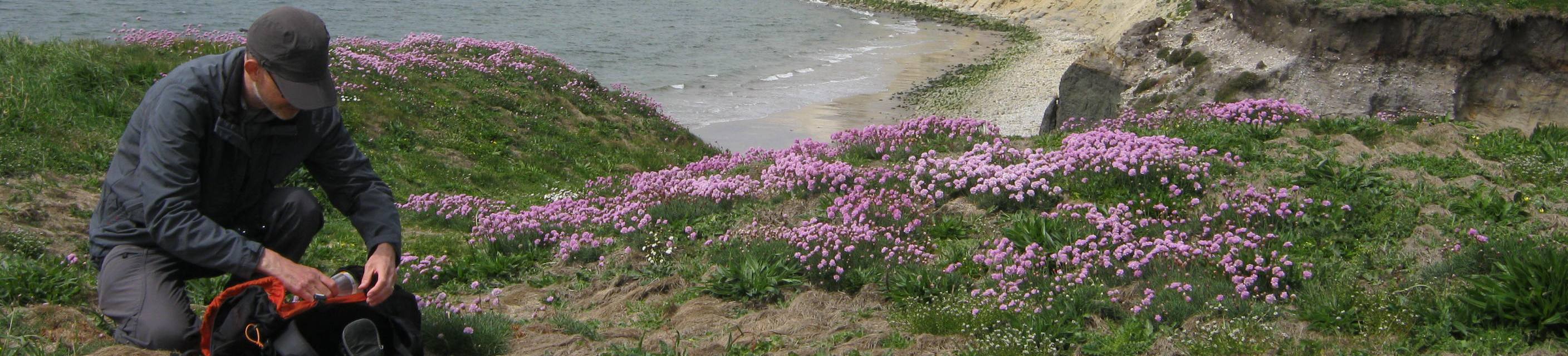
Thrift’s exuberant pink flowers have accompanied many of our holidays: on Isle of Wight cliffs, the Isles of Scilly, on Scottish coasts and islands and trips to East Anglian saltmarshes.

Thrift, Armeria maritima

Thrift, Armeria maritima, Isle of Wight, mid May 2016.

Also known as known as Sea Pink, Thrift is very much a plant of the seashore. It’s a member of the Plumbaginaceae (Leadwort family), along with Sea Lavender (Limonium), another coastal plant.

Thrift is a native perennial herb with compact evergreen cushions of needle-like leaves and long stems that bear spherical clusters of pink flowers. It grows on sea cliffs, stone walls, saltmarshes and stabilised shingle and its distribution in Britain follows the coastline. It is lovely as it flowers en masse, often made lovelier by a spectacular setting.

Thrift, Armeria maritima

Thrift, Armeria maritima, near Oban, late May 2018.

In East Anglia saltmarshes are often the best place to see it, though it grows on the cliff tops at Weybourne in North Norfolk. It can form extensive mats of foliage and on Annet in the Isles of Scilly, Geoffrey Grigson described walking across these as “a dream of walking on soft rubber that has squirted into flower” (note 1).

However, Armeria maritima is not just a seaside plant. It is very adaptable and can be found far from the sea too: on riverside shingle, windswept moss-heaths, stony flushes and on rocky mountain ledges, as high as 1,290 metres (4,200 feet) above sea level, on Britain’s fourth highest mountain, Cairn Toul in the Cairngorms.

Thrift, Armeria maritima

Thrift, Armeria maritima, island of Kerrera (near Oban), late May 2018.

Thrift tolerates the salt in sea water because it can excrete excess sodium and chloride ions via glands on the surface of its leaves. It can also can grow on old mine workings because it is able to deal with heavy metals (lead, zinc, nickel, cadmium, copper, chromium and arsenic) by excreting them or storing them in the cell walls of its roots (note 2).

Although the wild form of Thrift has pink flowers, there are cultivated forms with dark pink, red and white flowers. We have a dark pink form in our garden, probably either ‘Splendens‘ or ‘Düsseldorfer Stolz‘ (a.k.a. ‘Dusseldorf Pride’), though it wasn’t named when we bought it. The variety ‘Morning Star‘ is white. Given the choice, I would go for the original unimproved, pale pink wild form.

Armeria maritima makes a very good garden plant. It likes well drained soil and is very drought tolerant, making it a good candidate for growing on a green roof. It is hardy down to -10 or -15 Celsius (UK hardiness rating H5) and can cope with acidic, neutral or alkaline soils.

Thrift grew very happily in full sun on our rockery in North-east Scotland. Here in Norfolk, the three plants we bought about ten years ago have now spread to give a low green mat of foliage in our gravel garden. They need almost no maintenance, just an occasional trim when they start to cover the stepping stone path. Our soil is sandy but the plants are in a north-facing part of the garden and are in deep shade for six months of the year. They don’t seem to mind, although they will flower slightly later than plants in a sunny spot, which is the position the Royal Horticultural society website recommends.

Thrift, Armeria maritima

Mainly in shade, a dark pink Thrift, Armeria maritima, in our garden in Norwich, 28th May 2023.

The common form of Thrift is Armeria maritima subsp. maritima. Its flower stems are usually hairy and reach to 30cm (1 foot) tall. Each flower head is made up of a cluster of flowers, each with five petals, five pinkish stamens and yellowish anthers with cream-coloured pollen.

In the wild there is another form of Thrift, Armeria maritima subsp. elongata, known as Tall Thrift. It has smooth flower stems which can reach 55cm (nearly 22 inches) tall. It also makes a good garden plant but it is a rare plant in in British Isles. In the wild it is restricted to Lincolnshire (note 3).

In the 1950s subsp. elongata grew in at least 12 localities in Lincolnshire, but by 2000 most of these had been destroyed by agricultural “improvement” until just two sites remained, both within the same 1km square. Steps are now being taken to propagate plants and introduce them to nearby sites. One of these sites, Duke’s Covert, is featured on the Rushcliffe Wildlife blog, Wanderings, complete with a photograph of Armeria maritima subsp. elongata.

Outside the British Isles, Armeria maritima is native and has a widespread distribution in the Northern Hemisphere. Armeria maritima subsp. elongata has a more restricted range, occuring in Europe as far east as Ukraine, Belarus and part of Russia, from Iceland and Norway in the north down to Italy in the south.

The Plants For A Future website tells us that Thrift leaves are edible when cooked and that the dried flowering plant has antibiotic properties and has been used in the treatment of obesity, some nervous disorders and urinary infections. However, the plant is known to cause dermatitis or local irritation, so can’t be used externally as an antibiotic poultice. I haven’t tried eating it.

Richard Mabey speculates about the origin of the name “Thrift”. One theory is that it it is derived from “thriving” – the plant grows well in many places. But perhaps it refers to the way the leaves curl up to conserve water. “Thrift” also refers to economical management, economy and frugality and for this reason the plant was featured on the old thruppenny bit (British 3d coin) from 1937 to 1952. I used to have several of these coins but they stayed behind when I left home and I haven’t seen any for many years. John Grace kept his and there is a photograph of one on his Botany In Scotland blog.

Thrift with Small Copper butterfly

Thrift with Small Copper butterfly. Island of Seil, late May 2018.

If you’d like to read more about Thrift I recommend the Botany In Scotland blog. There are some excellent photographs, including close up pictures of flowers, on the Wildflower Finder website.

Notes

Note 1 – From from pages 112 – 113 of Richard Mabey’s “Flora Britannica” (Sinclair-Stevenson, 1996).

Note 2 – Thrift is a halophyte – a plant that is tolerant of salt. I wrote about another halophyte, Danish Scurvygrass, in May 2016. Danish Scurvygrass has been able to spread along our road network because of its tolerance of their salty edges. Thrift has been able to do this too, but to a lesser extent.

The Wild Flower Finder website explores heavy metal tolerance in plants.

Note 3 – The BSBI map shows a distribution spot in southern England too, described in the the Rushcliffe Wildlife blog, Wanderings, as “near Aldershot”. Presumably it’s an introduction but I haven’t been able to find out any more details of this site – please contact me if you know more.

Posted in Ornamental | Tagged Armeria maritima, Thrift

Post navigation

← Previous Post
Next Post→
Want to read more? Here is a full list of my blog posts.

Subscribe to Blog via Email

Enter your email address to subscribe to this blog and receive notifications of new posts by email.

Thirty latest posts

  • Fairy Foxglove, Erinus alpinus 27 February, 2026
  • Dwarf Thistle, Cirsium acaule 10 January, 2026
  • Zythia resinae (aka Sarea resinae) 30 December, 2025
  • Golden Conecap, Conocybe aurea 20 November, 2025
  • Five Fungi from Sweet Briar Marshes 23 October, 2025
  • Steccherinum oreophilum (aka Irpex oreophilus) – new for Norfolk 27 September, 2025
  • Orpine, Hylotelephium telephium 29 August, 2025
  • Wild Marjoram, Origanum vulgare 19 July, 2025
  • Goldilocks Buttercup, Ranunculus auricomus 5 June, 2025
  • Tree Lupin, Lupinus arboreus 28 May, 2025
  • American Skunk-cabbage, Lysichiton americanus 21 April, 2025
  • Cedar Cup, Geopora sumneriana 16 March, 2025
  • Cinnamon Bracket, Hapalopilus nidulans 13 February, 2025
  • Common Ragwort, Jacobaea vulgaris 13 January, 2025
  • Holly, Ilex aquifolium 7 December, 2024
  • Yellow Bird’s-nest, Hypopitys monotropa 24 November, 2024
  • Whiskery Milkcap, Lactarius mairei 8 November, 2024
  • Shaggy Bracket, Inonotus hispidus 25 September, 2024
  • Small Teasel, Dipsacus pilosus 24 August, 2024
  • Rothole Inkcap, Coprinopsis alnivora 1 August, 2024
  • Twinflower, Linnaea borealis 20 July, 2024
  • Foxglove, Digitalis purpurea 10 June, 2024
  • Beaked Hawk’s-beard, Crepis vesicaria 15 May, 2024
  • Thrift, Armeria maritima 17 April, 2024
  • Japanese Kerria, Kerria japonica 29 March, 2024
  • Golden Bootleg, Phaeolepiota aurea 12 March, 2024
  • Arched Earthstar, Geastrum fornicatum 22 February, 2024
  • Basil Thyme, Clinopodium acinos 3 January, 2024
  • Five Fungi from the Lanes of Norfolk 9 December, 2023
  • Five Fungi from the Streets of Norwich 21 November, 2023


All my posts

Complete list of blog posts


Select by date


Select by category

Site content copyright © 2012 - 2025 Jeremy Bartlett.
↑